Compliance & vCISO firms
Keep ownership of the SOC 2, ISO, and GRC program. Coordinate independent testing, report requirements, remediation, and retesting with the client and auditor.
Independent testing inside your client engagement.
For GRC and vCISO firms with client testing requirements, and product agencies needing independent validation before handoff. Start with a qualified client project and the delivery problem you need to solve.
Keep ownership of the SOC 2, ISO, and GRC program. Coordinate independent testing, report requirements, remediation, and retesting with the client and auditor.
Validate the applications, agents, retrieval systems, and tools you build before an enterprise launch or handoff. Define independent test scope and client authorization for each project.
Introduce a client with a defined requirement. DevBrows scopes and delivers directly, with any referral terms agreed separately in writing.
Retain the client relationship and coordinate delivery. Agree technical ownership, communications, report attribution, evidence sharing, and retest responsibilities.
Commercial terms can reflect committed volume, predictable scheduling, and delivery responsibilities. Test depth and scope remain explicit.
Choose SaaS pentesting, AI application and agent assessment, or an annual assurance plan for the client’s requirements. The report is tied to each authorized client scope.
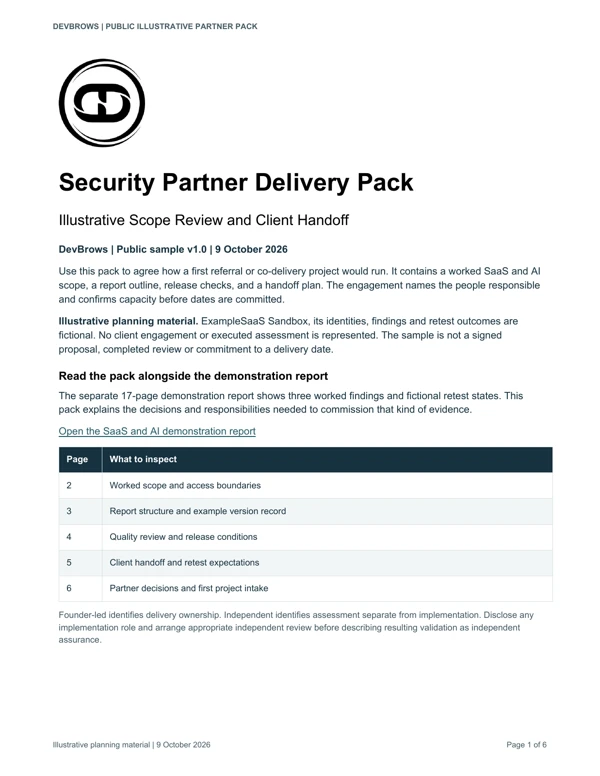
Inspect the sample scope, report structure, quality-review gates and client handoff expectations before discussing a first project.
Illustrative planning material. The example system and results are fictional. Dates, people, included time, retest window and commercial terms are confirmed in each proposal.
A fictional staging application and API, two tenants and six controlled identities. The worked scope covers report access, an agent refund tool and private memory.
Document control, an executive summary, coverage and authority maps, reproducible findings, remediation, retest status and an evidence appendix.
Agree a named, technically capable reviewer and four release gates. Record comments, corrections and the release decision.
Define who receives the report, who owns fixes, how scoped retesting works and which evidence can reach the buyer.
Start with one qualified client project. Confirm technical fit, report requirements and available capacity before committing dates. Review the first delivery together before agreeing reserved capacity or volume terms.
Custom scope-based commercial terms. Direct SaaS testing starts at $9,500; AI assessment starting scopes are $12K–$20K. Referral economics, co-delivery responsibilities, and committed volume are agreed in writing. Partner pricing does not imply reduced technical coverage.
Before work begins, agree delivery dates, authorized access, exclusions, data handling, and payment terms. Review our methodology and report expectations.
SOC 2/ISO readiness consultants, GRC and vCISO firms, MSPs serving software companies, and AI/product agencies that need independent validation before enterprise handoff.
Yes. The engagement defines relationship ownership, permitted client contact, escalation paths, confidentiality, report sharing, and commercial responsibilities.
White-label delivery can be discussed after agreeing client authorization, attribution, reporting, confidentiality, and operational responsibilities. Referral and co-delivery are the standard starting points.
Bring one qualified client scope, the report reviewer’s requirements, dates, expected project volume, and the problems you face with current delivery. We confirm technical fit, capacity, ownership, and client authorization before agreeing work.
Practical guidance for scope, evidence, and the next security decision.
Practical guidance for scope, evidence, and the next security decision.
Share your product, buyer requirement, and target date. We’ll confirm the engagement, deliverables, and commercial terms before work begins.