Methodology & engagement standards

Clear boundaries.
Evidence you can work with.

Agree the buyer’s report requirements, tested boundaries, evidence, engineering handoff, and independence before commissioning an assessment.

Illustrative delivery evidence

Inspect a complete demonstration report.

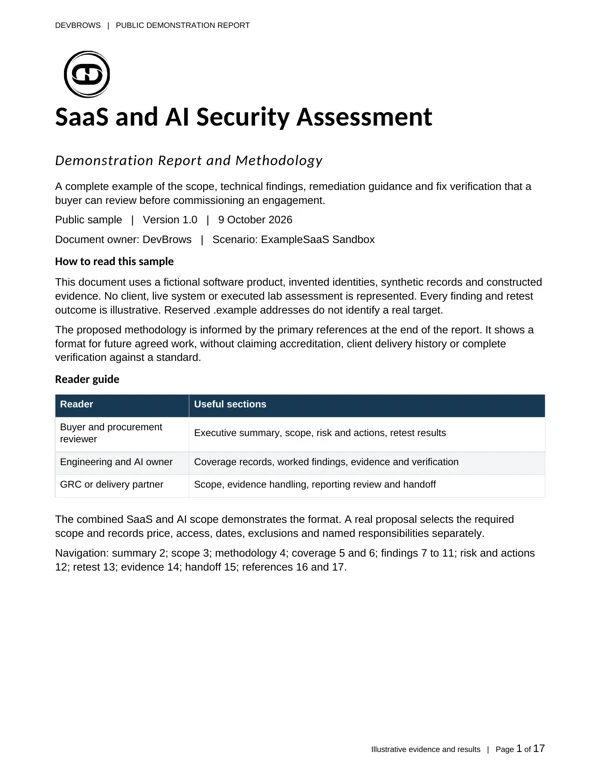
Cover of the DevBrows SaaS and AI demonstration report
Public sample · v1.0 · 9 October 2026

SaaS and AI security assessment

Follow a fictional assessment from scope and coverage through three worked findings, proposed fixes, and retest outcomes.

  • Role, tenant, workflow and AI tool-permission coverage
  • Reproduction steps, illustrative evidence and severity reasoning
  • Remediation guidance and fixed, partially fixed and not retested examples
  • Evidence handling, review checks and buyer handoff

Illustrative throughout. The system, findings, evidence and retest results are fictional. This is a demonstration of the report format, not a client result or an executed assessment.

17 pages · PDF · 301 KB · Free download

Before access

Define the engagement.

Scope and rules of engagement

Document the report reviewer and acceptance criteria alongside applications, APIs, roles, tenants, AI workflows, environments, test windows, permissions, exclusions, stop conditions, and escalation contacts. Confirm required tester qualifications before booking. Testing begins with written authorization.

Confidentiality and data handling

Agree NDA requirements, access provisioning and removal, approved test data, evidence storage and sharing, permitted tools, retention, and deletion expectations. Any use of third-party AI tooling with engagement data requires agreement.

During assessment

Trace a credible path to impact.

01 · Map the architecture

Identify identities, data flows, assets, dependencies, and trust boundaries. For AI, include model/provider routing, RAG, memory, agents, MCP, and tool execution.

02 · Validate manually

Use tooling to support discovery and coverage, then manually validate relevant findings in the agreed environment. Keep a technical contact available for clarifications and escalation.

03 · Document the limits

Record configurations, versions, accounts, preconditions, and exclusions. Separate observed findings from hypotheses, and note variability when AI behavior is not deterministic.

Illustrative scoping entries

Make the tested boundaries visible.

These examples show how a role, tenant, and workflow coverage matrix can be structured. They are planning examples, not completed tests or client results. The actual report adds versions, test status, evidence references, findings, and exclusions.

Example coverage entries to adapt during scoping
Identity and workflowExpected boundaryEvidence to record
SaaS member in test tenant A requests a tenant B exportThe web and API paths enforce tenant and role authorization.Test roles, synthetic record ownership, relevant requests, observed result, and coverage limits.
Support agent reads documents and invokes a refund toolRetrieval respects the user’s access; a consequential action requires the agreed approval.Agent identity, delegated scopes, tool-permission map, approval state, versions, and controlled trace.
A release adds a connector or changes a modelReview the new authority and data flow against the previous baseline.Change identifier, affected tests, configuration, regression result, fix status, and review decision.
What to expect in a report

Two audiences. One evidence trail.

Executive & procurement view

What was tested, and what matters.

  • Scope, dates, methods, and limitations
  • Business context and material findings
  • Prioritized remediation and current status
  • Clear distinction between findings and exclusions
Engineering view

Enough detail to reproduce and resolve.

  • Affected assets, versions, and preconditions
  • Reproduction steps and controlled evidence
  • Impact, severity rationale, and recommended fixes
  • Retest outcome for agreed findings
Illustrative finding structure · not a client result
Observation
Describe the permission or data boundary that failed.
Evidence
Record the authorized test identities, preconditions, steps, and observed result.
Impact
Explain which data or action became accessible and under what conditions.
Remediation & retest
Recommend the control change and record what was rechecked, including remaining limitations.

Download the complete illustrative report, then discuss your buyer’s report requirements during scoping. The proposal records the agreed deliverables.

After findings

Make the evidence actionable.

Walkthrough and retest

The proposal defines included engineering workshop time, remediation ownership, and one scoped retest for SaaS and AI assessments. Record each agreed fix as verified, unresolved, or not retested, with conditions and remaining limits. Substantial implementation is separately scoped.

Assurance for change

Record changes to models, tools, data, permissions, and architecture against the tested baseline. Use the findings and expected workload to choose targeted follow-up or an annual plan. Continuous AI Assurance supports an agreed cadence with versioned regression and change records.

Founder-led delivery

A named team, with clear responsibilities.

Founder-led describes delivery ownership: Jimmy leads security work and client scoping; Dev leads engineering and tooling. Independent describes the assessment’s separation from implementation. Confirm the delivery owner, report reviewer, and any implementation role during scoping. Meet the founders and review their work.

Our reports support engineering, procurement, and audit evidence. They do not certify a system, guarantee buyer acceptance, or replace a SOC 2 or ISO audit.

Implementation and independent review

Make delivery roles explicit.

Remediation advice and fix verification are part of the agreed assessment. If DevBrows is separately engaged to implement a fix, document that role and arrange appropriate independent review before describing the resulting validation as independent assurance. Disclose who implemented, tested, and reviewed the change, along with any limits on independence.

Start with a scoped conversation

Bring the requirement.
We’ll define the right scope.

Share your product, buyer requirement, and target date. We’ll confirm the engagement, deliverables, and commercial terms before work begins.